Incremental, my dear Watson.
First you need a bike.
In 2019, after a second-hand mountain bike had rusted in the shed for 10 years, I decided it was time to get a road bike. I didn’t know that I would use it often, so I spent as little as possible on something that would not fall apart. I bought the Brand X road bike for £270 and it was brilliant. It now sits on a trainer in the garage, still in service.
After doing a time trial and a sportive for fun I started to feel the limits of its weight and basic gears. In the big ring there was not quite enough power on downhills. In the small ring, I suffered the humiliation of having to walk up Toy’s Hill. So in August 2020 I upgraded to a much lighter Canyon with a grown-up set of gears.
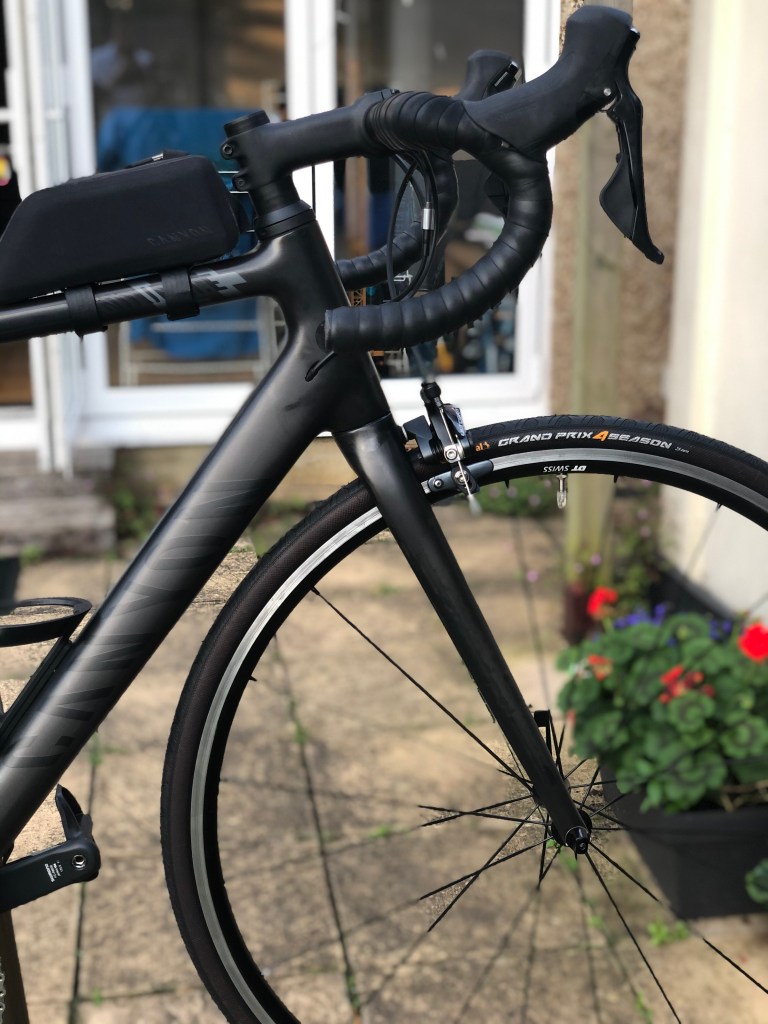
As with the bike itself, everything else related to cycling was acquired in increments and through a slow process of optimisation. If something was needed, lost or broken or causing pain, I bought a new one.
On the ‘classic’ package for the Ride Across Britain you can take one bag up to 90 litres and 16kg in weight. Bearing in mind the need to cycle nearly a thousand miles and camp for 9 days, this was my final packing list.
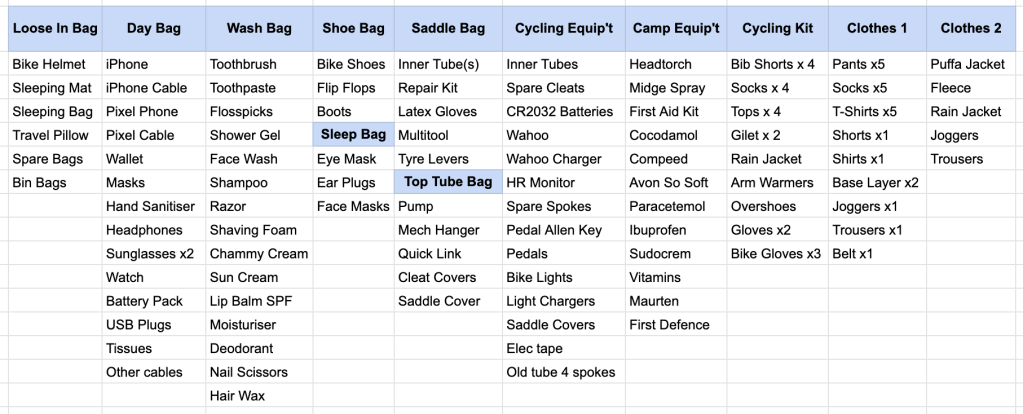
Those curious about the details may read on…
- Headphones – Aftershox Aeropex are perfect for cycling. Rating: 5* after testing all year.
- Sunglasses – Two pairs of Oakley Radar Path EV for sunny vs cloudy conditions. Rating: 5*
- Boots – Aigle rubber boots. Rating 4*, a little heavy, I am between sizes.
- Latex Gloves – For when your chain comes off or when you get a flat tyre.
- Multitool – The Ride Across Britain mechanics recommended the Topeak Hexus X. Rating: TBC.
- Mech Hanger – This is the little bracket that your rear ‘mech’ hangs from. Your rear ‘mech’ is your rear derailleur, the mechanism that moves the chain from cog-to-cog on the cassette at the rear of the bike. It is usually specific to your bike, so worth having a spare in case it breaks. In my case Canyon have a page where you can find the right one.
- Spare Spokes: As above, they are typically specific to your wheels, and small enough to tape to the top tube or hide inside the seat stay. DT Swiss have a page.
- Midge Spray / Avon Skin So Soft: The midges in Scotland are said to be voracious and, in their ability to bite humans, second only to the feared wild haggis. Both Smidge and Avon Skin So Soft are recommended. Rating: TBC.
- Maurten Hydrogel Powder: The latest, legal and safe performance enhancing substance from the pro peloton. Sports drink mix which uses a seaweed extract to allow the gut to absorb higher levels of carbohydrate, aimed to counteract the problems that come with taking on too many carb gels. Rating: Hard to know. It tastes okay. Sadly I won’t have room for more than a couple of sachets. The Ride Across Britain uses High5 products, which are pretty good.
- First Defence: Aimed to catch any colds before they develop. Rating: Hard to know.
- Bib Shorts: Covering 5,000km in training and on the ride justifies a significant R&D budget. I’ll withhold ratings until after the ride but I have shorts from Bioracer (Epic) and Le Col (Hors Cat II) among others.
- Saddle: Ditto. In my case, I aimed for something that fitted my sit bones really well and the Specialized Power Arc Expert seems to do the trick.
- Bike Socks. Not rocket science but I really like the ones from Canyon.
 The Cycling Eagle