In setting up this blog I significantly overestimated my ability to write gripping prose while shattered.
But here goes.
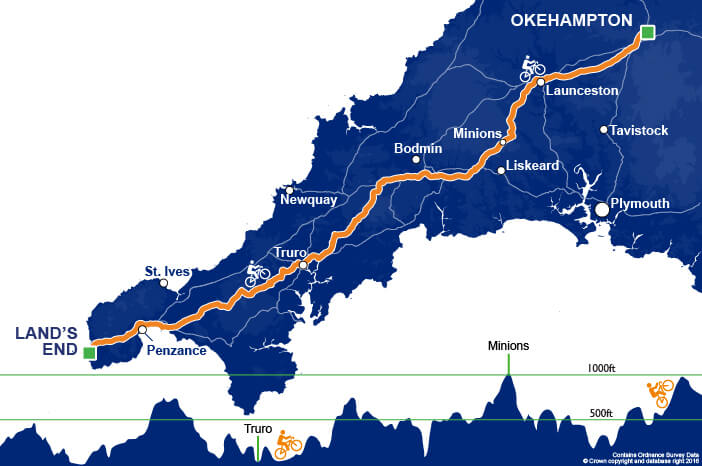
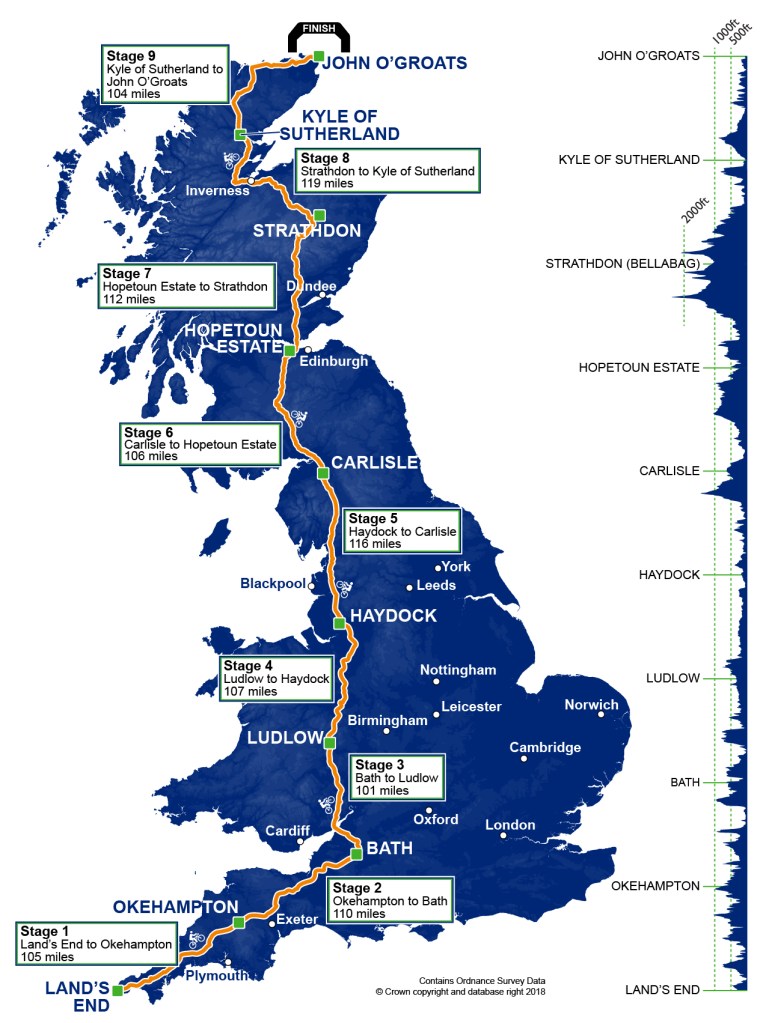
We got a bus to Land’s End on Friday 3rd September, set up at Base Camp and went for a photo with ‘the sign’ (normally £7, free for us).
A girl saw the line of cyclists and shouted up: “Well done!” “We haven’t done it yet, we’re going the other way round!” Her friend, disbelieving: “Where are you going?” “John O’Groats” “Where’s that??”
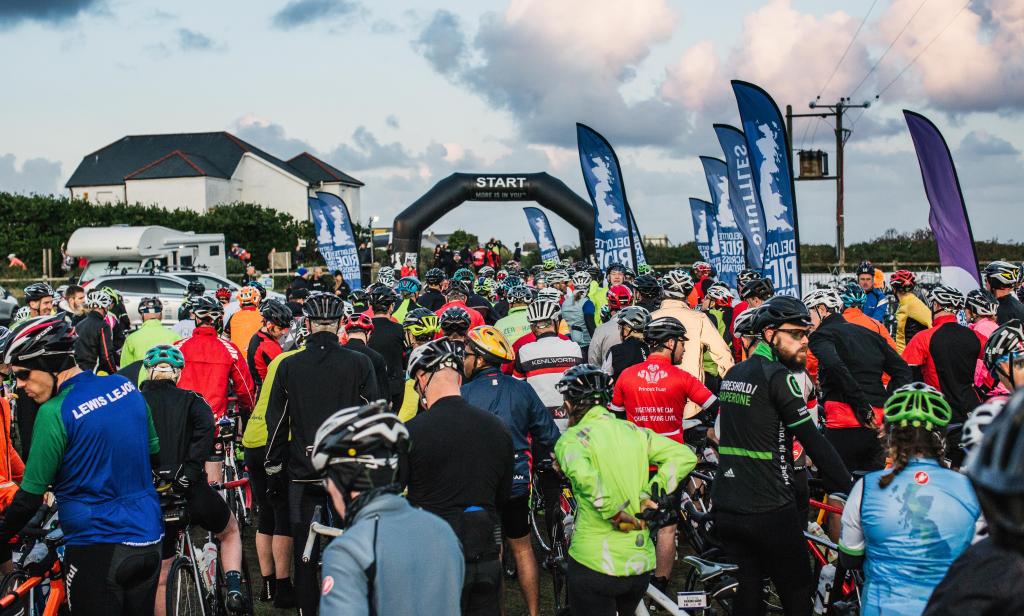
At 5.30am on Saturday 4th September, Freddie Mercury belted out of the PA system, summoning hundreds of bleary-eyed cyclists out into the mist.
“I want to ride my bi-cycle, I want to ride my bike”
We shuffled into the main tent and the smell of bacon met our nostrils. One enormous breakfast later and we joined the start line, released in groups into the wild, propelling ourselves through the first glorious hour of two hundred and sixteen before reaching the tip of mainland Scotland.
Families of riders dotted the route and children waved. The race photographer overtook, perched on the back of a motorbike to catch our clean, smiling faces.
The first past of the stage took us through foggy, windy downs. Giant wind turbines loomed and turned slowly, a grim reminder of the monotony of every pedal stroke to come. Cows and sheep watched us pass, nonplussed. A buzzard pinwheeled across the sky. We said hello to fellow riders.
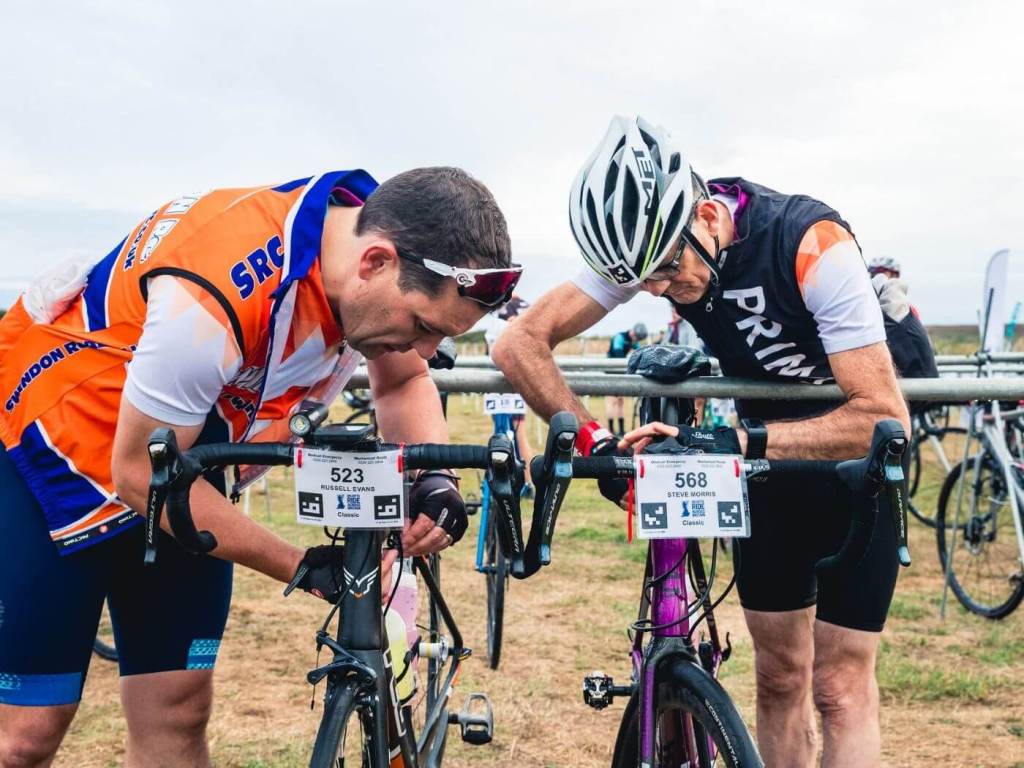
Our first pit stop came after 50km (30 miles), in a car park perched at atop a fierce climb. The queues moved quickly as taps blasted out fresh water and rider picked bars, gels or cakes.
The sun finally broke through the clouds as we stopped for an unexpected road closure. A hour passed and the whole field backed up at the top of a steep descent, 30 of us stuck at the bottom.
Rerouting 950 cyclists is no simple task and requires police approval. It duly came and we forced ourselves back up the steep hill to rejoin the main group and take a long, hot detour to the next pit stop.
As I talk about hills here I may run out of adjectives and repeat myself ad nauseam. In Cornwall and now Devon they are numerous, relentless and unkind, despite revealing bucolic vistas.
Gazing in wonder at the scenery just about lasted the evil climb up to beautiful village of Minions. By the long drag up to Okehampton I was not in the mood to look to my right at the splendid Dartmoor National Park.
The sun beat down, everything hurt and to continue to pedal was to enter a trance state in a fight against the body’s screams to stop. Seeing other riders around you cope – including many older than me, a man on a BMX and a couple on a tandem – was a strong incentive.
We rolled over the line exhausted, and at dinner heard with trepidation the briefing for day 2: longer and possibly harder than day 1.
A 5am start was no match for the breakfast line, which snaked out of the marquee and deep into the campsite. It was 7am before we crossed the start line, having packed everything in our bags to be taken by truck to the finish.
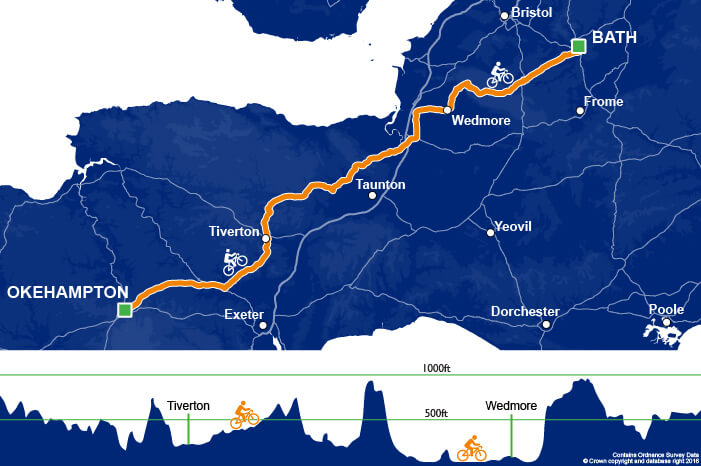
Rather than the constant up and down of Cornwall, Devon promised bigger, longer climbs and descents. Somerset held in store the Quantock hills and even some flat roads.
If we were hurting from the hundred miles on day one (and we were) there was plenty of perspective on offer. During the day we overtook a man on a BMX, another man with a prosthetic arm and the couple on the tandem, all riding the same 970 miles to John O’Groats.
Rather than research in advance Cothelstone Hill, the first major obstacle, we arrived at it and saw the road bend up steeply into the trees at an impossible gradient – like something out of the movie ‘Inception’.
A long climb it was, with two diabolical ramps reaching 20% in gradient. Many fellow cyclists got off and walked. We engaged our lowest gears and stamped on the pedals, barely overtaking those who went on foot.
At the top, supporters cheered and rang cowbells, holding flags and banners that brushed out helmets as we crawled past.
Next the flying descent at 68kph (42mph) down to the Somerset Levels, cooled by the rushing air and the pain relieved temporarily from the legs.
At last there was no gradient and I had my first experience of riding in a ‘train’, where one rider takes a turn on the front and eats wind while the others line up behind and shelter.
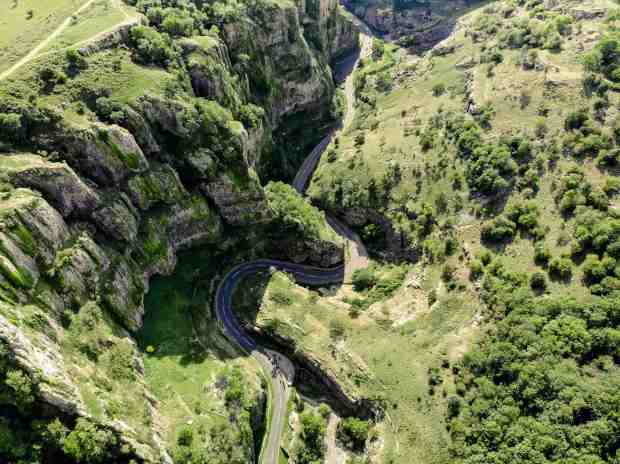
With great collective pace we arrived at the foot of Cheddar Gorge, carved out by ice over a million years. At what felt like the same glacial pace, we took the steep, winding road up the gorge, limestone cliffs towering above.
We rode caerphilly gouda the village, but the tourists looked at us like we must brie emmental, as if we were edam fools. Quickly, they were proven right and the climb started to grate.
Race photographers dotted the Gorge and we tried to exchange grimaces for smiles as their shutters opened and closed.
We hit the top and struggled through some more rises before the long downhill into Bath City Centre. Scores of riders were stacked up at traffic lights, between cars and like fish out of water.
Finally, with 2 days and more than 200 miles in the legs, the savage, long climb up the other side to Bannerdown tried to separate us from the finish line, showers and food.
It landed some heavy blows, but failed, and we lived to start Stage 3, which took us up through Wales to Ludlow.
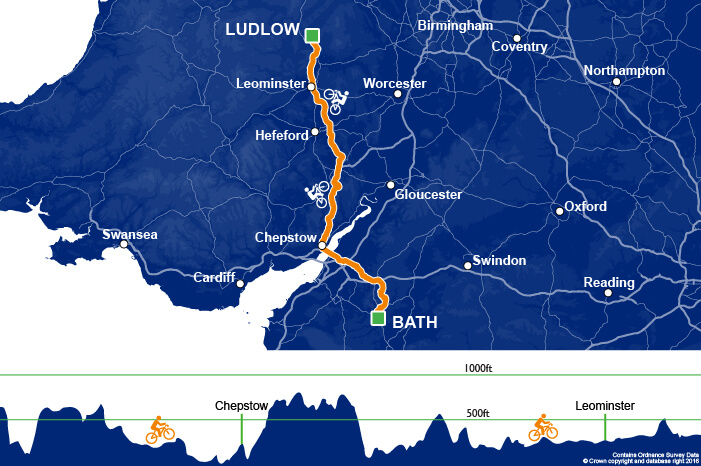
It’s practically a rest day, they said, as we woke up at 5am and left at 7am to cycle 94 miles from Bath to Ludlow.
Thick, cold mist clung to the hillsides and a washed out sun peered through it across freshly-harvested fields. Country lanes took us to the Severn Suspension Bridge, where we crossed a mile of water as if through a cloud, only the sound of foghorns giving away the shipping beneath.
We entered Wales and quickly dipped down to our first pit stop at Chepstow Castle. Hundreds of cyclists filled the car park, filled bottles and took selfies. Within five minutes of the restart the road turned upwards, and everyone regretted their sausage rolls, as the gradient didn’t stop, climbing all the way back into England.
What goes up, must come down, however. And we did, on a long, long fast wooded descent towards Ross-on-Wye.
At the morning stage briefing, race technical director Andy Cook said that the section of road alongside the River Wye past Hole-in-the-wall is his personal highlight of the entire 9-day route.
It didn’t disappoint. Imagine cycling through an oil painting on a warm summer’s day, waiting for two skittish horses to be guided off the track by their riders, the wide river snaking through birdsong, woods and flowers.
By now the sun was beating down and all 27 degrees Celsius was radiating back off the tarmac, sweat soaking cycling jerseys and salt forming on brows.
From the river we faced long, steep climbs through narrow lanes up towards the second pit stop at Fownthorpe, where everyone fed and watered in the shade.
I walked alongside another rider on my way back to the bike.
Me (making polite conversation): “How did you find that last climb?” Rider: “Not too bad, I just took it steady. How about you?” Me: “It was quite hard in the heat, but I managed it”
We went our separate ways and I realised I had been speaking to Elinor Barker, one of the most decorated riders in the history of British Cycling. She and her boyfriend had agreed to ride the day for for fun and she had been interviewed on stage in the marquee the night before.
So, my innocent question was pretty much like asking Serena Williams: “How was that last forehand? Was it okay?”
Coming out of Fownhope we rose some more before longer, faster roads made up the remaining 50km (30 miles). A huge chain gang formed at pace that I wasn’t comfortable with but preferred to the alternative: getting dropped and riding on my own. Kudos to Ed and the aptly-named Malcolm Sherriffs (surely 15 years our senior) for enforcing the pace with some big turns on the front.
Counting down the kilometers we rolled down into Ludlow and someone shouted from a car. We caught up at the traffic lights and realised it was our friend Claire with her Mum and Luca – they had been tracking us via a shared link after we missed our meet point.
They beat us up and down the hill in the town centre, but we pushed on strongly to the racecourse. They only just made it out of the car to see us pass the finish line, confusing onlooking punters, who had bet on Tiger Roll in the 2.30.
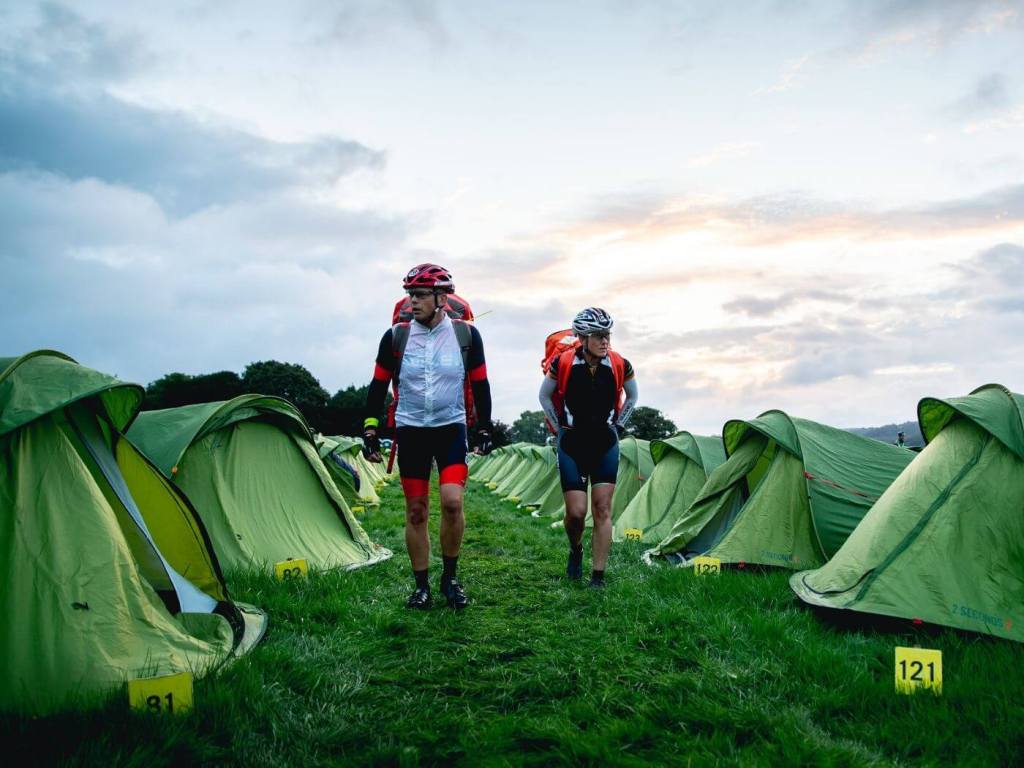
One third of the way to John O’Groats and very sore, we hit the tents, as trains rattled past and flocks of geese honked overhead.
They said you will have your low moments and that everyone has them. Mine came late on the evening after Stage 4 when I was meant to be writing this entry, in our campsite at the centre of Haydock racecourse.
I decided to shelve writing and get some sleep. About 20 yards away a huge floodlight powered by a noisy generator kept everyone awake. One woman took matters into her own hands and turned it off, to a smattering of applause from people in tents and surprise from people using the light to brush their teeth.
Despite this commotion I passed out and woke up at 4am feeling much better and ready for Stage 5. Perhaps I had just been tired after going beyond my limits four days in a row.
The day itself took place under two different skies, one cool under mist and fog, the other under blazing hot sun.
This was genuinely a flatter day, so we ate up the ground to the first pit stop and powered on. Mostly on narrow country lanes, we made our way through Staffordshire and into Cheshire.
Then, finally, the traffic. For the first time in our ride, long tailbacks of cars and lorries blocked progress and huge groups of cyclists formed between or alongside them. Progress seemed glacial compared to the speed we were making before.
We used some London cycling experience to make headway and escaped back into the countryside, where really bad roads rattled our bones as we tried to enjoy the views. We arrived at Middlewich Football Club for the second pit stop and drank cold cans of coke sitting in the shade of a hedge.
There was one more stop planned: to see my aunt and cousin in the car park of a garden centre on our route. I hadn’t seen them since well before the start of the pandemic and they are knowledgeable about cycling, as my cousin used to be a mechanic for pro racing teams.
It was a great lift to see them, even if it could only be brief, so that we could leave before seizing up.
33km (21 miles) remained on mostly flat roads but with some traffic. I found these last sections each day the hardest. Everyone was keen to get home and fast groups formed, which it felt impossible to back down from. Plus, we already had more than 140 km (90 miles) in the legs.
I just clung on to a group with Ed and we made it to Haydock for some entry-level corporate hospitality and another night under canvas.
We woke to a hazy sunrise over the racecourse and took longer than usual to get ready. It was laundry pick-up day so we retrieved the cycling gear handed in the night before.
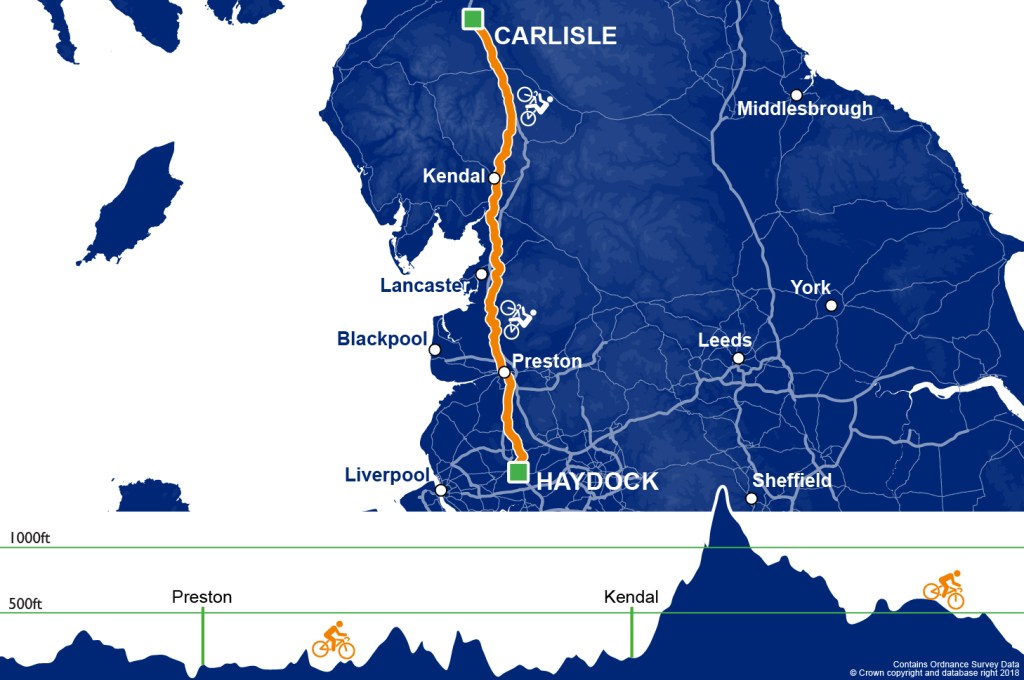
By the time we got to the bike racks, they looked deserted: we were almost the last to leave. However, we made up time cutting past traffic in the suburbs of Preston.
We entered the Lune Valley and started criss-crossing the M6 on the country lanes North. The sun was out again but at this stage the temperature was still comfortable.
Gradually winding, we entered the Trough of Bowland. Country lanes lined with dry stone walls rolled through the landscape, with farms, hills and mountains beyond under a deep blue sky.
At some point here we passed halfway from Land’s End to John O’Groats – a banner at the second pit stop marked the achievement and riders queued up to send photos to family and friends.
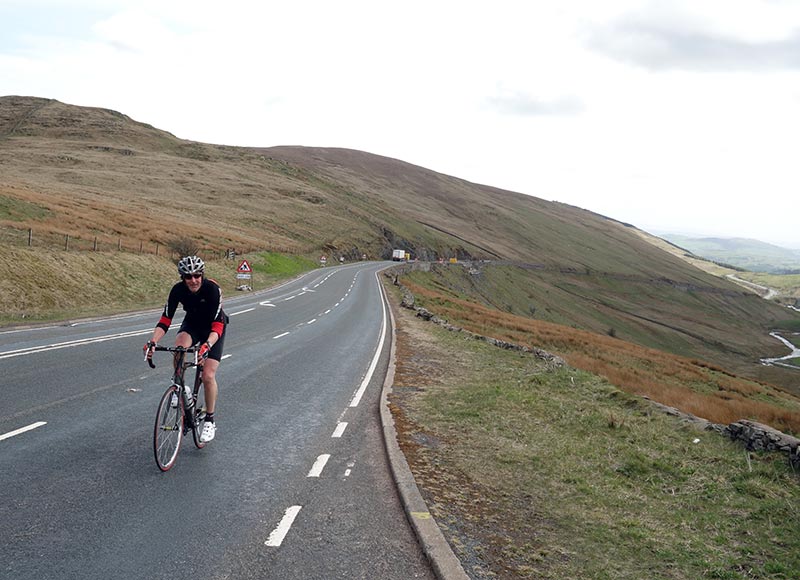
All the talk was of Shap Fell, which loomed on the day’s elevation profile, rising for 15km (9 miles) out of Kendal, into the Lake District to an altitude of 420m (1,378ft).
We formed a group with Andrew and Zoe, a couple from Canterbury, and tried to set a challenging pace we could all manage.
As we approached on the busy main road, cars and trucks hurtled past and the sun reached its apex above our heads.
The scale of the scenery was suddenly much bigger. Even after the lower slopes, Kendal and Bowland looked tiny over our shoulders to the left. Each turn revealed more huge, mountainous landscape, clad with heather and grazed upon by a few hardy sheep.
Now came the last push to the summit, a long drag, where you could see exactly what was to come from the line of cyclists dotted up in front. The temperature hit 30 degrees and we all hit our limits.
Everything felt like heat and pain, and no breeze brought relief. Only getting off the bike, or reaching the summit could end it, and I was not getting off. We put in a final surge and – around 50 minutes after we started climbing – made it to a group of supporters, who cheered and rang cowbells.
As we waited for Andrew, more riders finished to the same plaudits, their faces red and sweat dripping onto their bikes.
The descent over the other side was long, fast, cool and bliss. We only hit 66km/h (41mph) but it felt much faster compared with the upward slog before.
In the village below was an extra drinks stop, next to a school where the children were out cheering the riders. We hid in the shade and drank cold fizzy drinks from the shop over the road.
Passing a farm, a huge banner on the side of a truck declared: “Ash and Dean smashing it from Land’s End to John O’Groats”. More family and further banners dotted this part of the route, cheering on not just the eponymous pair, but each of us that passed.
With 150km (93 miles) already covered, the 40km remaining would be the ‘hard bit’ – or at least the next edition of scores of ‘hard bits’ so far.
We climbed through Penrith and onto the long, straight, rising and falling A6. It was hot, exposed and there was nothing left in the tank, but riding as a group we eventually made it to the turn off at Carlisle, into country lanes again and a very steep final few kilometers.
Cresting the top of one steep rise, we saw cyclists sitting to our right, unable to resist the lure of a pub at the top of a hill.
They tried to persuade us to join them, but we knew that to stop for one pint would be to stop forever. On we pushed and suddenly the base camp appeared on the right, with yet another nine hours done, utterly exhausted.
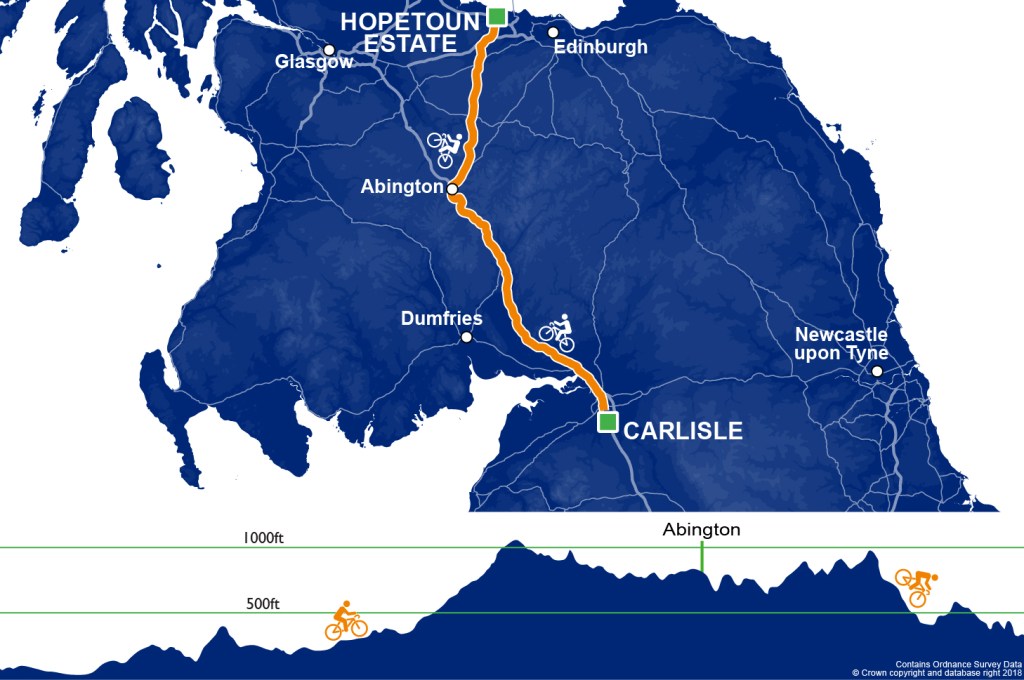
We cycled from Carlisle, in England, to Edinburgh, in Scotland. It was not a route made for cyclists.
The ‘old’ roads north run alongside the motorway and the train lines, but lie in disrepair. The occasional lorry thundered past an abandoned Little Chef restaurant as we chugged along the horrible surface, our whole bodies rattling, hands and bums sore.
The weather had finally regressed to the mean so we rode through showers and some wind. The advice was to look up at the view and writing this a few hours after finishing, it is now easier to pick out the highlights.
First, a huge, wide valley that was like being inside a model train set. In the distance, a tiny train ran alongside a river. A motorway swept through. Pylons carried electricity between distant towns. Cows and sheep grazed on the flanks of the hills, contained by stone walls.
Second, having to stop behind a herd of cows as a farmer and sheepdog ushered them down the road to the next field. The dog prowled low to the ground at the back of the group, snapping at their tails.
Third, climbing up onto a small moor where an army of giant wind turbines slowly rotated in thick fog. There could have been thousands of them, ready to attack.
With each day, the section from the last pit stop to the finish gets harder and harder. This trend was continued, as everyone was more tired yet simultaneously pushing hard to get back to Base Camp for food and rest.
We crossed the finish at a wet field in the Hopetoun Estate, with enormous relief.
First: to the queue for the physio team, where so many waited to be forced back into shape. My neck and quads were in bits but soon made more bearable via painful massage.
We took hot showers, dropped off our laundry and after 5 days gave in to a couple of beers as all 900+ people crowded into the marquee for dinner.
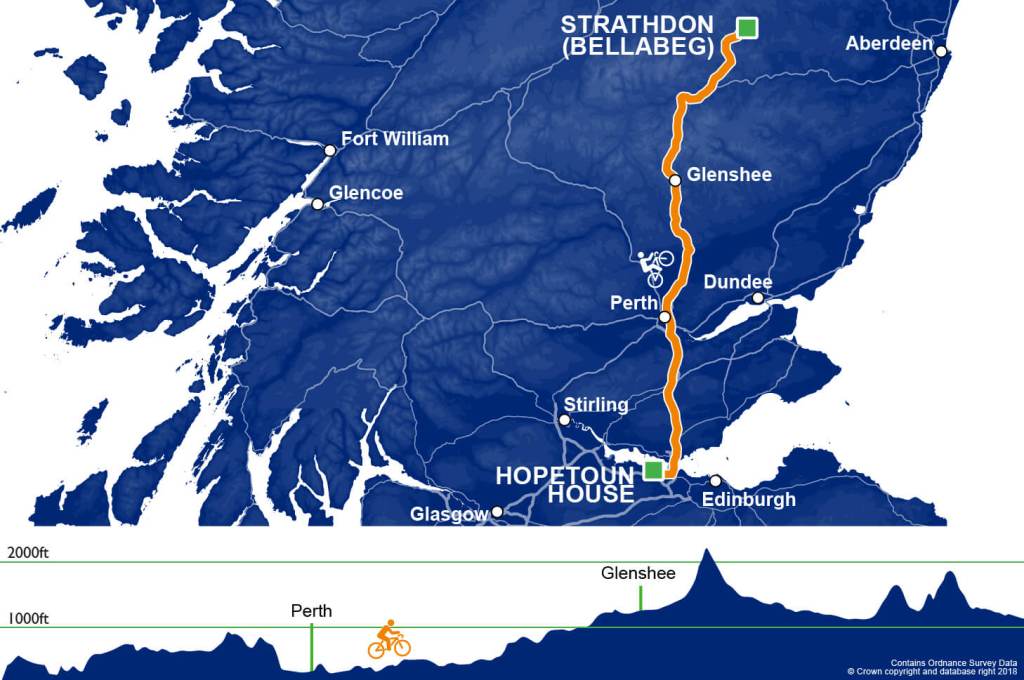
Tomorrow is rated 5/5 for difficulty, tackling the steep ramps of the Glenshee Ski Hill, past the Queen’s summer residence at Balmoral and into the Cairngorm mountains.
However, at more than two-thirds of the way there, there is a growing sense we can do it.
“When I wake up, well I know I’m gonna be, I’m gonna be the man that wakes up next to you”
The proclaimers rang out from the PA system for the 5.30 AM wake up call. Occasional showers doused the campsite.
The start line opened at 6.30am but we were to meet Graham – an in-law of Ed’s – at 7am and he would ride with us for a while. He completed the event in 2019 so was happy to join us, even in the rain.
I was tardy getting my things together so Ed set off and I almost rode right by the two of them in my urge to catch up.
There are three bridges crossing the Firth of Forth at Queensferry, just to the West of Edinburgh. We took the middle one and could just see the other two beyond thick fog.
As Graham left to return home, we rode in rain to the first pit stop at Perth Racecourse. Bagpipe music played from a speaker as hundreds of cyclists came in, filled bottles, ate snacks and rolled out again.
Our first highlight was cycling alongside the ‘World’s Biggest Hedge’. The Meikleour Beech Hedge, which was planted in 1745, is one third of a mile long (530 m) and 100 ft (30 m) high.
The second was a really steep descent on a good road surface where my bike computer claims I hit 105.2km/h (65 mph). I was starting to feel the joy of letting rip downhill, judgement and bike handling honed by 8 hours of practice each day.
The main event was to be the ascent of Glenshee. Ed and I were riding again with Zoe and Andrew, both surgeons, whom it turns out have completed several ‘Ironman’ triathlons each and all the major climbs in the Alps, including several in the same day. Typically, Andrew would be stronger on the flat while Zoe would be quicker uphill and we would try to stay with her.
After some warm-up climbs we entered the long valley. Right at the end was the mountain itself, the road rising from the left at the base and wrapping up and round to the right. What we could see was steep and dotted with tiny cyclists. Beyond that lay an unknown stretch to the road’s summit.
We attacked it at whatever pace we guessed would be sustainable and from this point there was no backing down. The climb was 2.8km (1.7 miles) at 8.6% average gradient, but as we rounded the corner we saw the final ramp of over 12%.
There were no smaller gears left, just out of the saddle or in the saddle, keep going or fall off. On the ramp I decided to go all in quite early and saw my heart rate rise towards max, tunnel vision for the summit.
Ed made a surge and passed me on the right but I was absolutely in the red and couldn’t respond. He pulled out a lead of 7 seconds by the summit and we both stopped at the side of the road, breathing heavily. Zoe followed not far behind with Andrew coming in a couple of minutes later.
Immediately the relief of stopping and adrenaline of the effort combined for elation. We talked and joked with the ‘Belgian Train’ – a strong group of riders in national colours who often hurtled past on the flat but whom we nearly caught when going uphill.
We dropped down over the other side to our second pit stop at the snowsports centre, where ski lifts disappeared further up the barren slopes. There was no snow, but the temperature was falling and sweat from the ascent was cooling us too quickly, so we put on arm warmers and jackets.
Ready to go again, we embarked down into the next valley. As the climb felt like so many I watched in the Tour de France, so did the descent. We were quickly up to 65 km/h (40mph) and there was great visibility of the long turns below, plus other cyclists to call out problems with the surface.
Hands on the drops, fingers on the brakes and head tucked down, I felt the exhilaration of speed and control, the joy of a corner perfectly taken, the freedom compared to the slow progress uphill.
The valley was flanked left and right by steep slopes and a shallow, clear river flowed beautifully alongside us over clean stones. Sheep watched us whizz past, a stone bothy (shelter) stood high and alone above the river.
Ahead, a thick mist, which we realised was rain. We entered it and the drops smashed down on us, plumes of water thrown up from tyres. Just as soon as we had entered the storm we left it behind, still descending with barely a pedal stroke required.
Now on the flat, we passed Braemar Castle (c1628) and turned left off the main road for what turned out to be another long climb with some very steep pinches over 12%. For all the talk of Glenshee as the main event this was one of three stings in the tail.
We turned upwards through a pine forest, over a cattle grid and up single-track roads into heather-clad moorland. We rested at the top a moment as other riders arrived, puffing and panting and swearing about what was gone and what was to come.
The next descent was shorter and more technical but still fast, requiring careful use of brakes and moving of bodyweight to enjoy it to the full.
Yet another climb came, much shorter but with a terrifying ramp of 20% towards the top. In the lowest gear and full gas on the pedals was the only way to move – and with pedals clipped in the alternative was to fall over. I crested this one first in our group but with around 160km (100 miles) in the legs I wondered how much more I could manage.
Down the other side and we saw a long road rising up the side of the next mountain. We realised there were no other roads in sight, so this was the one we would be taking. Expletives uttered, we tried to gain momentum coming in but this quickly expired and all that was left was our own effort.
Zoe broke away but I managed to catch her and we rode at a limit, in stalemate, to the summit, with Ed and Andrew just behind. We were all stronger than we thought we could be as we faced each burning pedal stroke, with yet another challenge overcome. We could survey the world below us knowing that we had earned it.
Knowing now that the climbing was done, we could sweep down towards Strathdon, as if on a victory lap. We saw Base Camp on the right and crossed the finish line amid cheers from the friends and families of other riders.
After waking during the night as rain lashed the campsite, I was not at the races in the morning, and we didn’t leave until nearly 7.30am, when few bikes were left in the racks.
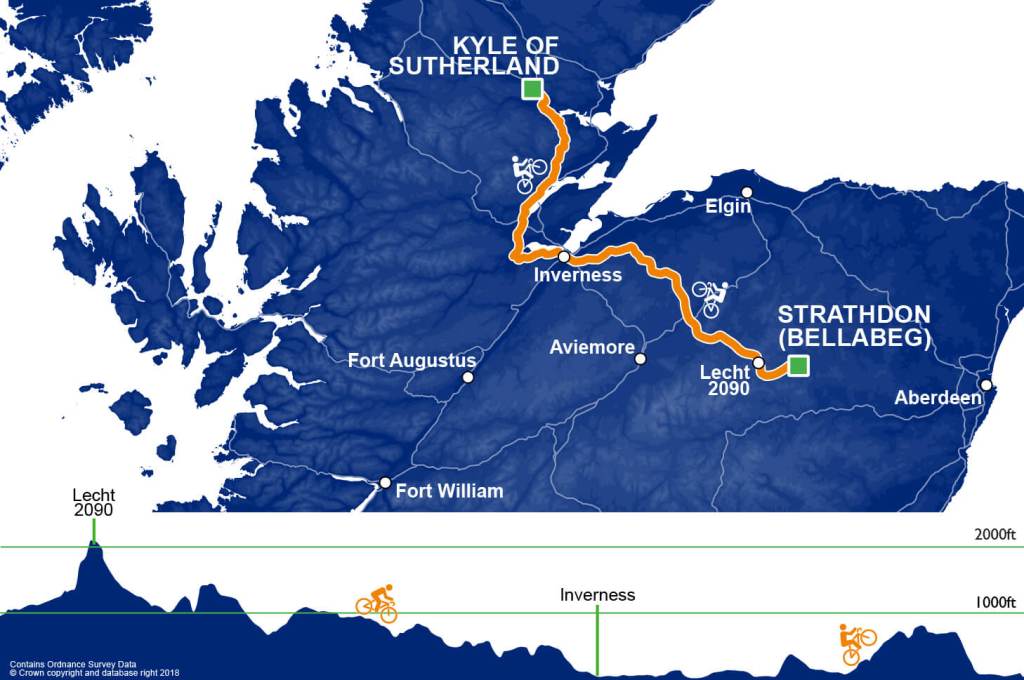
The main event came after less than an hour. It was the stupendously hard climb of ‘The Lecht’.
We rounded a corner and saw the first 20% ramp. Half the cyclists were walking up, the others zig-zagging across the road.
We joined them and tried not to go too hard too quickly. In reality all we could do was stand up, grip the handlebars hard and stamp on the pedals.
We barely passed the walking cyclists, so slow was our progress. After the first ramp was merely a very steep hill, then the rest of the climb revealed itself: a short descent followed by more fearsome ramps to the summit.
Hearts pounding and legs screaming, we turned the pedals right on our limits, desperately trying not too go too far into the red.
This time Ed couldn’t surge past me and I waited for him at the first summit for a moment as supporters cheered and rang cowbells.
We climbed together up to the ski station, then hurtled down the descent to Tomintoul. A road sign to our first pit stop at Grantown-on-Spey said ‘14 miles’ (23km) – nearly there, we thought.
The unforgiving Scottish landscape had other ideas.
The route sent us up into barren moorland with strong winds and cold rain. As we were battered by the elements we made slow progress, barely able to see, water spraying up in plumes off rear wheels into the faces of riders behind.
It took well over an hour to roll into the pit stop, where fortunately the rain had abated. Cold, damp, riders peeled off gloves and joked with each other. A couple hugged for warmth.
From there, a sharp turn off the main road took us onto a long, narrow and winding trail through pine trees and gorse bushes. Gravel in the middle of the trail and many blind bends demanded full concentration, for another hour or more.
With little warning, we rounded a corner and could see down to the huge expanse of the Moray Firth, the town of Inverness to the West, the great inlet from the sea, the hills and mountains beyond.
In Scotland, where we would spend almost half our ride, incredible views like this were often reward for our long toil uphill.
It was a steep descent to Inverness and we passed quickly into the docks. The passenger in a car, held back by our peloton, leaned out of the window and shouted unintelligible profanities as he shot past. The smell of wood chips drifted from a colossal storage depot, the contents spilling from behind barriers.
High above, the Kessock Bridge carried the A9 road North across the Firth. We picked up a cycle path which rose to the bridge and crossed it separately from the cars.
A gale-force crosswind battered us from the left and made it hard to stay upright and pedal. Powerful currents shifted below as the sea entered the land, stretching further than the eye could see. We felt like insignificant specks compared with the scale and power of nature on display.
The process somewhat repeated at the Cromarty and Dornoch Firths. As we moved North we climbed upwards into cold, rainy moorland, saw the sea entering the land and dropped down to cross it.
By the time we crossed at Bonar Bridge, we were cold, tired and spent, after another eight hours in the saddle, the last two of which were spent dreaming of hot showers.
It was the last night of Base Camp and after another enormous meal, the thousand-plus riders and crew crowded into the marquee to hear closing speeches from the organisers.
Wet clothing hung in the drying tent. Guards watched the bikes. Drizzle fell and wind buffeted the empty tents. The queues for physio, medical and showers temporarily disappeared.
One stage remaining. 105 miles (167km) to the very North of mainland Scotland. Colder and darker than the ride so far, but with the end in sight.
The events of 2020 have made it crystal clear that huge and urgent investment in lab innovation, early-stage testing and large-scale clinical trials, can fight global disease.
This is exactly what Cancer Research UK does, without financial backing from the Government. However, it’s not all they do. For example their information nurses speak to thousands of people each year as they struggle to understand a complex disease; and their fundraising events are not just about making money, bringing people together to help them face their challenges together.
If this sounds like the sort of thing you want to support, you can donate here:
We woke at 4.30am in the cold and dark of Northern Scotland, already well prepared.
After 9 days of camping we were pretty good, but the day took on that extra significance, so packing was done to perfection the night before, during the night and first thing in the morning.
Everything I didn’t need was at the bottom of the big bag. Everything to go on the bike was on one side in the tent. Things I needed to get ready were in the small bag, which would go in the big bag at the last minute, all to travel by truck.
Chammy cream was rubbed into bib shorts and they were donned for the last time. A long-sleeved jersey was covered with a gilet, a raincoat in the back pocket. Gloves, bike computer and sunglasses sat collected in my helmet. Two filled bottles and fully charged lights were already on the bike.
Breakfast started with a cup of tea left outside my tent – thanks Ed – then finished in the marquee with the usual: bacon, sausage, egg, beans, porridge, croissants.
We crossed the start line at 6.13am, still in darkness and following winking rear lights up the road. We had just over 100 miles (160km) to our final destination. Even with all my layers on I was cold, but within ten minutes it felt bearable.
The light slowly grew as quiet lanes picked their way through ferns and pine trees. The road ran alongside a rushing river and up into wide expanses of moorland, the sun breaking through clouds clinging to the mountains in the East. We climbed and descended on good roads, still cold but surprised by the rich scenery.
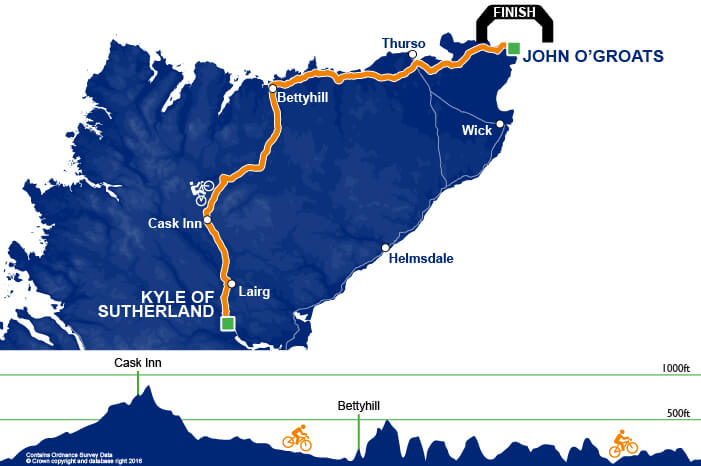
We made rapid progress towards the first pit stop at Altnaharra, where thick clouds of midges filled the air. All the staff were wearing head nets, except for Roy, who is in charge of the water. As Ed put it: Midges don’t bite Roy. Roy bites midges.
We refilled, restocked and toileted in record time and could already feel the midges make pinpricks all over our faces, ears, legs. Our fellow riders rushed around and swore, surprised to have found a new level of discomfort in a 9-day world of pain.
In the morning I had remembered to put on ‘Avon Skin So Soft’, supposedly the midges’ Kryptonite. In the end this merely reduced the number of bites to ‘scores’ rather than ‘hundreds’, based on the exposed skin of other cyclists.
We ate on the move as we rode away from the carnage, alongside Loch Naver. It was a long body of water, enough that in the South we rode in dappled sunlight and in the North we rode inside a raincloud with a headwind.
The climb to Bettyhill took us alongside a Sandy creek to the North Coast Road, heading East. We had cycled beyond the rain and it was warmer except from the occasional gust of wind. The final pit stop was just off the road in a car park and a handwritten chalk sign said ‘Just 31.4 Miles!’ (50.5km).
Having made more than 300,000 pedal strokes to that point since Land’s End, everyone faced significant wear and tear so it was hard to know what was worth mentioning. But the pain in my right knee was starting to reach levels where I couldn’t use it and I dropped behind the group (Ed, Zoe and Andrew) on a simple climb.
It turned out I could survive by using only my left leg, or by getting out of the saddle to stand on the pedals, but our average speed came down. No-one seemed to mind as we were already making good progress along the long, straight roads.
The Orkney Islands lay across the water, wind farms turned far out at sea, a farmer and a sheepdog sat atop a quad bike, herding sheep. We counted down the miles and looked for any sign of the finish.
At last we spotted flags and coaches in the distance and knew that we had made it. Relief and jubilation were finally allowed.
We had set off at 06:57 on Saturday 5th September 2021. After 9 days and 976 miles (1,571km), with 65 hours and 59 minutes in the saddle, we rounded the last corner and heard the announcer read our names as we passed the finish line. The large crowd of supporters cheered.
A photographer crouched just beyond the line and we tried to pose without falling over on the wet grass. The main organisers were there congratulating riders and their team handed out medals.
Wearing them with pride, we walked our bikes back to the road and freewheeled down the hill to get a photo with the ‘sign’. No paywall here, just a line of happy, exhausted cyclists and some friends and family. The photographer took official snaps and fellow riders used phones to capture the moment for themselves.
Our final jobs were to pack our bikes for transit and get ourselves on a coach back to Inverness. We attached pipe lagging, removed pedals and handed over our tired machines, frankly glad to see the back of them. After months obsessing over saddle heights, gear ratios and tyre choices, we would have happily thrown our bikes into the sea.
We joined the standby queue for an earlier bus and got onto the 4.20, at last feeling like we were done. We sat at the front, near the driver and with a great view forward. The lady with the clipboard and high-viz jacket walked on and congratulated us, saying the journey would take 3 hours, if we didn’t get stuck behind any tractors or cyclists.
Riders were still coming in so the driver waited for a while before pulling out onto the road, then turned and set off. Before long we were, briefly, stuck behind a cyclist. In fact I recognised Stuart, whom I had spoken to a couple of times when we ended up riding next to each other. Slim and probably in his late forties, he had a distinctive skull tattoo on his right calf, and some days wore walking boots rather than cycling shoes.
As the road was taking him away from the finish, we guessed that he was doing the ‘extra’ 24 miles (39 km) that some wanted to ride in order to make up 1,000 miles in total.
It wasn’t for us. Instead the relief that we could just sit down on a soft seat and do nothing, then later walk on a carpet, eat in a restaurant, and sleep in a bed.
The driver overtook Stuart and we sped off down the rolling coastal lanes, leaving him to his bike, the wind and the roads.
We had done it. From the southern tip of England to the northernmost point of mainland Scotland, under our own steam. We battled steep hills and long flats, blazing heat and freezing cold, saddle sores and injuries, exhaustion and sleep deprivation – but we defeated them all.
Our reward was relief and elation, thousands raised for charity, and memories for a lifetime. The iconic climbs, the stunning views, the fast descents and the remarkable people. In particular, huge respect for those less suited to the challenge than us but able to do it anyway for a charity or cause they believed in.
During one evening, there was a presentation to around 30 riders of a ‘Gold’ jersey to recognise their third time completing the ride. I couldn’t catch the whole thing but my friend Rich from work was likely one of them. He completed the distance in 2018 and 2019, before working as a chaperone in this years’ event – cycling up and down the route helping other riders each day.
So at times the question came up: “would you do it again?” and my answer was: “fair play to those who do, but it’s not for me”.
There will be other, fresh challenges ahead, both those I choose and those thrown at me by life. Whatever they may be, at least I know that we all have within us what it takes to keep going, when all we want to do is get off and lie down.
In 2019, after a second-hand mountain bike had rusted in the shed for 10 years, I decided it was time to get a road bike. I didn’t know that I would use it often, so I spent as little as possible on something that would not fall apart. I bought the Brand X road bike for £270 and it was brilliant. It now sits on a trainer in the garage, still in service.
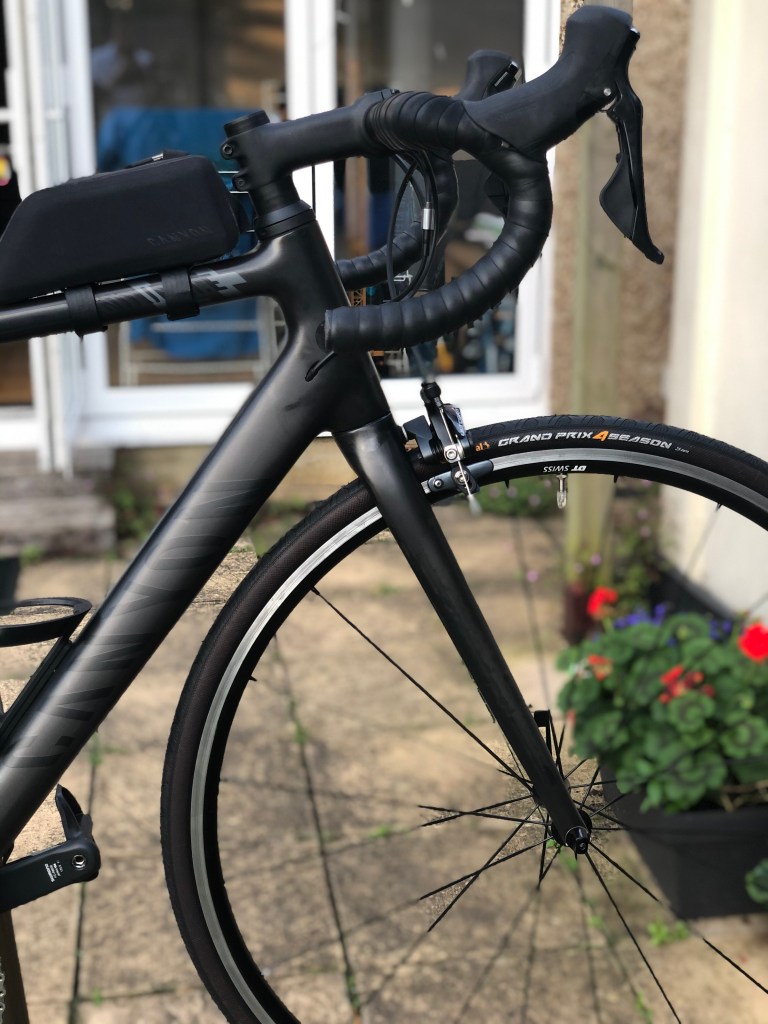
After doing a time trial and a sportive for fun I started to feel the limits of its weight and basic gears. In the big ring there was not quite enough power on downhills. In the small ring, I suffered the humiliation of having to walk up Toy’s Hill. So in August 2020 I upgraded to a much lighter Canyon with a grown-up set of gears.
As with the bike itself, everything else related to cycling was acquired in increments and through a slow process of optimisation. If something was needed, lost or broken or causing pain, I bought a new one.
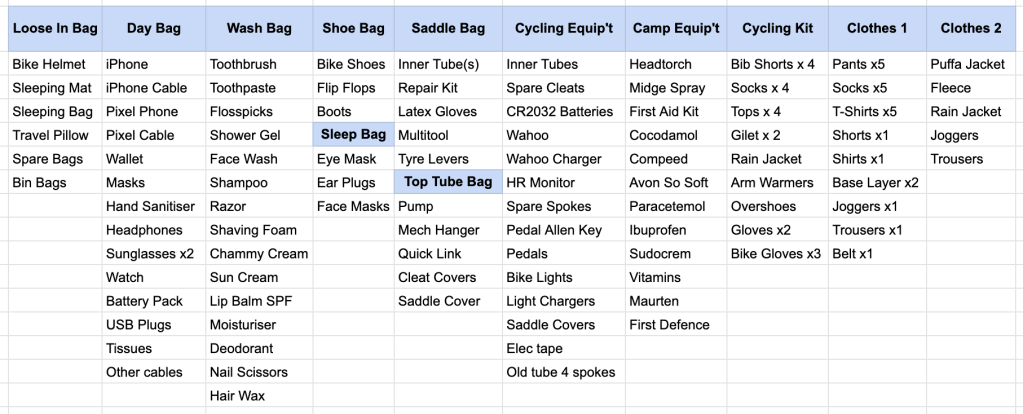
On the ‘classic’ package for the Ride Across Britain you can take one bag up to 90 litres and 16kg in weight. Bearing in mind the need to cycle nearly a thousand miles and camp for 9 days, this was my final packing list.
Those curious about the details may read on…
Headphones – Aftershox Aeropex are perfect for cycling. Rating: 5* after testing all year.
Sunglasses – Two pairs of Oakley Radar Path EV for sunny vs cloudy conditions. Rating: 5*
Boots – Aigle rubber boots. Rating 4*, a little heavy, I am between sizes.
Latex Gloves – For when your chain comes off or when you get a flat tyre.
Multitool – The Ride Across Britain mechanics recommended the Topeak Hexus X. Rating: TBC.
Mech Hanger – This is the little bracket that your rear ‘mech’ hangs from. Your rear ‘mech’ is your rear derailleur, the mechanism that moves the chain from cog-to-cog on the cassette at the rear of the bike. It is usually specific to your bike, so worth having a spare in case it breaks. In my case Canyon have a page where you can find the right one.
Spare Spokes: As above, they are typically specific to your wheels, and small enough to tape to the top tube or hide inside the seat stay. DT Swiss have a page.
Midge Spray / Avon Skin So Soft: The midges in Scotland are said to be voracious and, in their ability to bite humans, second only to the feared wild haggis. Both Smidge and Avon Skin So Soft are recommended. Rating: TBC.
Maurten Hydrogel Powder: The latest, legal and safe performance enhancing substance from the pro peloton. Sports drink mix which uses a seaweed extract to allow the gut to absorb higher levels of carbohydrate, aimed to counteract the problems that come with taking on too many carb gels. Rating: Hard to know. It tastes okay. Sadly I won’t have room for more than a couple of sachets. The Ride Across Britain uses High5 products, which are pretty good.
First Defence: Aimed to catch any colds before they develop. Rating: Hard to know.
Bib Shorts: Covering 5,000km in training and on the ride justifies a significant R&D budget. I’ll withhold ratings until after the ride but I have shorts from Bioracer (Epic) and Le Col (Hors Cat II) among others.
Saddle: Ditto. In my case, I aimed for something that fitted my sit bones really well and the Specialized Power Arc Expert seems to do the trick.
Bike Socks. Not rocket science but I really like the ones from Canyon.
A bit further, or a bit harder, whenever you have a gap
Life is what happens while you’re making other plans, said John Lennon, or perhaps Allen Saunders.
In this vein, it must be said that everyone undertaking an endurance challenge first has their own idea of how much training will be enough, but second must face the reality of what is possible alongside other commitments.
I set out to follow some of the milestones in the Ride Across Britain Training Plans, and fit what I could around them.
The Intermediate Plan contained the following waypoints, for a September start. Bear in mind the end goal, which is to be able to ride around 110 hilly miles / 170 km per day for 9 consecutive days.
Jan – 250 miles total / 402 km (Done)
Feb – 100 mile ride flat / 160.9 km (Done – Tour de Greggs)
I didn’t hit the milestones from April. Spending consecutive days out for 6 hours at a time was not compatible with having a job and a family. But after doing London Revolution (155 miles / 250km) then 1,000 km in total during July, I felt ready.
On most days I only had time for shorter rides, so I rode harder, aiming for new PBs on Strava segments with recovery between. Outdoors, I never rode intervals at specific power, cadence or speed, instead going with the road and the conditions. The milestone distances were ridden with my partner in crime Ed, who is taller and slightly broader than me and provided a helpful draft.
In general, I tried to maintain 150 km (93 miles) per week come rain or shine. By the summer, I increased to 300 km (186 miles) per week, before tapering from mid-August.
To keep myself interested indoors, I rarely rode the same course on Zwift and tried many different group rides and workouts. In real life, I had a well-worn route round Richmond Park that would start at 25km (15.5 miles, 55 mins) then could be dialled up with more laps or going harder on each lap.
Over time, I gradually learned routes all over Surrey and Kent, occasionally repeating Box Hill or a 100km (60 mile) loop, but often exploring new roads, inspired by the rides of others on Strava and Ridewithgps.
Indoor rides paused due to large spider coming too close: 1
Buzzard attacks on steep climbs: 1
Overall, my strategy was firstly ‘go a bit further or a bit harder, whenever you have a gap’, secondly ‘only go if you want to’ and thirdly ‘once you’ve started, don’t give up’. Time will tell, but I think it worked out.
Land’s End to John O’Groats (LEJOG, or vice versa, JOGLE) is a time-honoured challenge first undertaken by Robert and John Naylor on foot in 1871.
When…the question arose. “Where shall we walk this year?” we unanimously decided to walk from John o’ Groat’s to Land’s End, or, as my brother described it, “from the top of the map to the bottom.”
Since then, many have tried, failed and succeeded in both directions and by all means imaginable – walking, unicycling and even on a motorised toilet – but the allure of this epic journey remains.
The Ride Across Britain 2021, an organised event, is a chance for amateur cyclists to undertake this feat of endurance, across 9 days, 969 miles (1,559km) of road and 52,500 feet of climbing (16,000 m).
Several hundred riders set off early from Land’s End on Saturday 4th September 2021, facing headwinds, hills, rain, traffic, midges, saddle sores, potholes and punctures for up to 12 hours each day.
Two feed stops are provided during each stage and those who remain ahead of the ‘broom wagon’ reach the finish on time and avoid recording a ‘strike’ (three and you’re out).
Tents, showers and hot food are available at ‘base camp’ each night. Mechanics are on hand to fix serious equipment failures. The medical team recorded 1,200 cases of “looking at sore bums” in 2019.
There’s no doubt that it’s a challenge. The Ride will cover more road than the professional Tour of Britain, which will follow just a day behind. Few participants are athletes, and the transition from life at the desk to life on the road, is going to hurt. However, it should be free of some of the risks of the late 19th Century.
The roads were still far from safe, and many tragedies were enacted in lonely places, and in cases of murder the culprit, when caught, was often hanged or gibbeted near the spot where the crime was committed.
The choice to go from South to North is motivated not by elevation, because to take the same route is to go up and down the same amount. It’s mainly because the prevailing wind is from the South, and because getting to Land’s End is easier than getting to John O’Groats for most people.



 The Cycling Eagle